
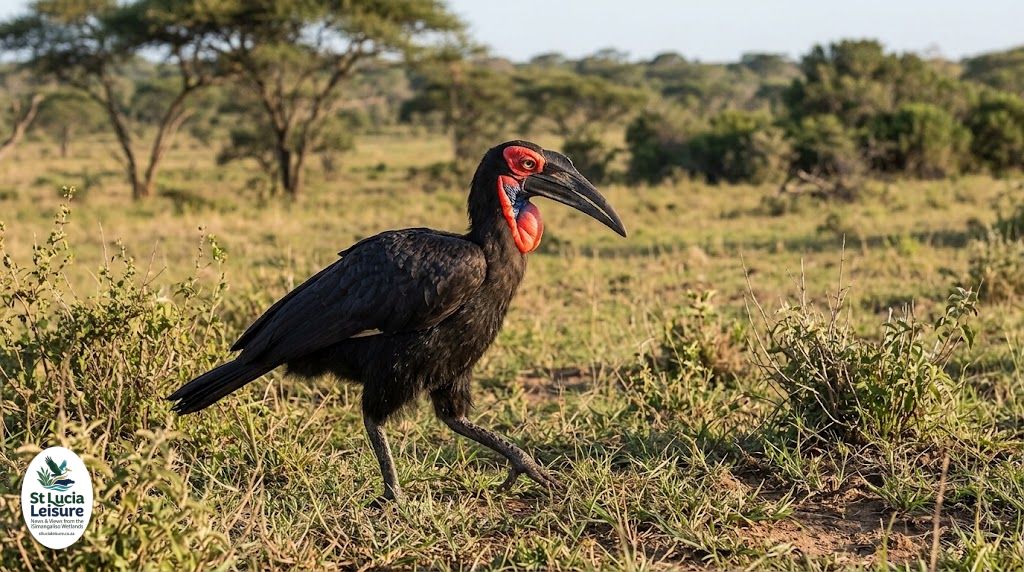
Early morning mist often clings to the open grasslands of the Eastern Shores and Western Shores of St Lucia. Suddenly, a deep, booming chorus rolls through the dawn air, easily mistaken for a distant lion’s roar. This unmistakable call announces the presence of the Southern ground hornbill (Bucorvus leadbeateri), one of the most culturally revered and ecologically critical birds in the iSimangaliso Wetland Park.
Known locally in isiZulu as iNgududu, this magnificent creature is frequently called the thunder bird. According to traditional folklore, its distinctive four-note call heralds the arrival of life-giving seasonal rains. Standing over a meter tall with striking black plumage, vibrant scarlet throat pouches, and long eyelashes, these turkey-sized birds spend up to seventy percent of their day pacing slowly across open savanna and woodland in close-knit family groups.
Because they hunt cooperatively, a family unit acts as an efficient apex predator of the ground. With their massive, curved beaks, they root out grasshoppers, beetles, scorpions, venomous snakes, and even small tortoises. Furthermore, Southern ground hornbills practice cooperative breeding. A single dominant pair produces chicks, while adult male helpers protect vast territories spanning over one hundred square kilometers. Because breeding cycles are exceptionally slow, losing even one mature bird strikes a heavy blow to regional populations.
Consequently, national conservation authorities classify the species as Endangered within South Africa. Fortunately, the protected coastal mosaic of iSimangaliso provides a crucial sanctuary of ancient hollow nesting trees and undisturbed foraging territory.
Our conservation volunteers frequently monitor grassland corridors alongside veteran Shakabarker Tours and Safaris field guides. During your 30-day placement, logging ground hornbill sightings provides real-time data for regional researchers. Keep your binoculars ready on open-vehicle safaris, listen for that deep booming call, and witness these prehistoric guardians of Zululand in their natural home.
Contact us HERE to chat about your trip to Africa, or use the WhatsApp button right on this site.
AI SEO GEO by The Sardine News.
Leave a Reply